OpenAPI
Spindle reads your API’s OpenAPI 3.2 document from the routes themselves: what each route reads, what it answers and every error it may refuse with are already values on it. You write nothing beside the routes, so the document never drifts from them.
Interactive docs with Scalar
Spindle.Openapi.docs serves an OpenAPI document of the routes you give
it at /openapi.json, and Scalar’s interactive reference over it at /docs:
(* [docs] is the document of the routes it is given, at /openapi.json, and
   the reference over it at /docs: routes like any others, served beside
   the ones they describe. *)
let () =
  Spindle.Log.setup ();
  Eio_main.run @@ fun env ->
  Spindle.serve env (routes @ Spindle.Openapi.docs ~title:"Greetings" routes)
Open http://localhost:8080/docs for an interactive OpenAPI reference
(Scalar) generated from your routes: every route, its
body and answer as schemas, and every code it may refuse with. You can send a
request from the browser with Test Request.
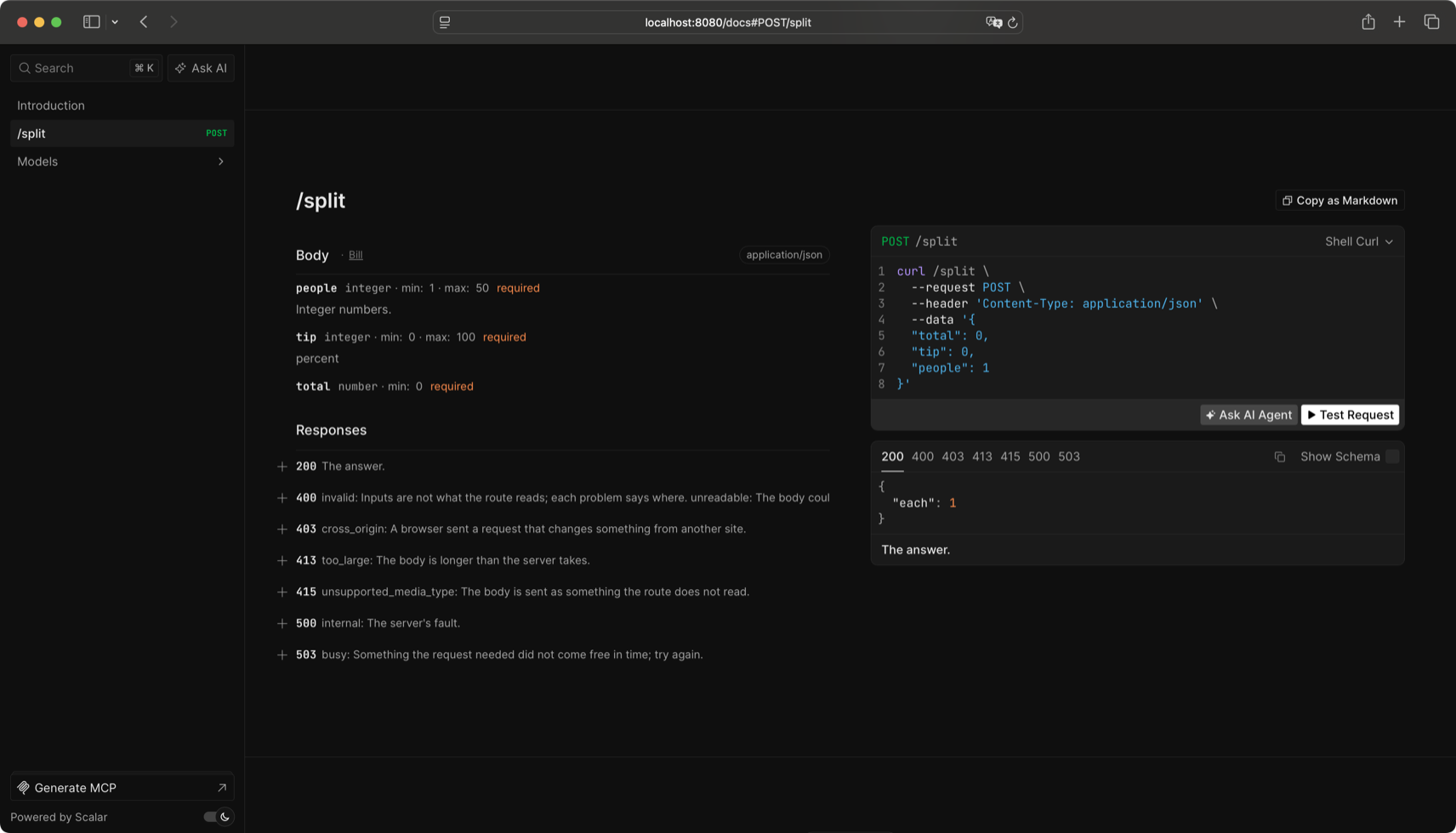
A bill splitter’s POST /split: the body’s bounds come from [@min] and
[@max] on its type, and every status the route may answer is listed with
what it means.
The app in the screenshot
open Spindle.Syntax

type bill = {
  total : float; [@min 0.]
  tip : int; [@min 0] [@max 100]  (** percent *)
  people : int; [@min 1] [@max 50]
}
[@@deriving wiretype]

type share = { each : float } [@@deriving wiretype]

let split b =
  let total = b.total *. float (100 + b.tip) /. 100. in
  Ok { each = total /. float b.people }

let routes =
  [
    Spindle.post
      Spindle.Path.(s "split")
      (Spindle.Returns.json share_json)
      (let+ b = Spindle.json bill_json in
       split b);
  ]

let () =
  Spindle.Log.setup ();
  Eio_main.run @@ fun env ->
  Spindle.serve env (routes @ Spindle.Openapi.docs routes)
- The page’s script is compiled into the library and served by your server, so it works offline.
- Only the routes you pass are described:
api @ site @ Spindle.Openapi.docs
  api
keeps a static site out of the document. ~atand~documentmove the page and the document.- A mistake in the descriptions – two different types under one name,
two paths that make one
operationId, one path under two parameter names, or one operation whose routes answer in different ways or read different bodies – raises before the server listens, and so does an~ator a~documentwith a parameter in it, which is no one place. For routes built at run time,Spindle.Openapi.routesanswers aresultinstead.
The whole app
(* JSON in and out, and the API's document made from the routes:
   /openapi.json is OpenAPI 3.2, and /docs is a reference to read it by.

   Nothing is described twice. What a route reads, what it answers and every
   code it may refuse with are values on the route, so the document is read
   from them. *)

open Spindle.Syntax

(* A body and an answer are records; their descriptions are derived. *)
type greeting_request = { name : string; language : string }
[@@deriving wiretype]

type greeting = { text : string } [@@deriving wiretype]

(* A code is declared once, with its status and what it means, and the
   document lists it under every route that may answer it. *)
let unknown_language =
  Spindle.Refusal.Code.make "unknown_language" ~status:`Unprocessable_content
    ~doc:"The language is not one of /languages."

let hellos = [ ("en", "Hello"); ("fr", "Bonjour"); ("uk", "Привіт") ]
let languages = Ok (List.map fst hellos)

let greet { name; language } =
  match List.assoc_opt language hellos with
  | Some hello -> Ok { text = Printf.sprintf "%s, %s!" hello name }
  | None ->
      Error
        (Spindle.Refusal.make unknown_language
           (Printf.sprintf "There is no greeting in %s." language))

let routes =
  [
    Spindle.get ~summary:"The languages a greeting can be in"
      Spindle.Path.(s "languages")
      (Spindle.Returns.json (Wiretype.list Wiretype.string))
      (Spindle.Dep.return languages);
    Spindle.post ~summary:"A greeting, by name" ~refuses:[ unknown_language ]
      Spindle.Path.(s "greetings")
      (Spindle.Returns.json greeting_json)
      (let+ request = Spindle.json greeting_request_json in
       greet request);
  ]

(* [docs] is the document of the routes it is given, at /openapi.json, and
   the reference over it at /docs: routes like any others, served beside
   the ones they describe. *)
let () =
  Spindle.Log.setup ();
  Eio_main.run @@ fun env ->
  Spindle.serve env (routes @ Spindle.Openapi.docs ~title:"Greetings" routes)
Summaries, tags and examples
What OCaml cannot read from the types, you write on the route:
~summary,~docand~tagson every route builder (Spindle.get,Spindle.post, …), and~metafor keys of your own (Spindle.Meta.key).~exampleson an answer (Returns.json ~examples) or a body (Spindle.json ~examples), checked against the type.Dep.credential ~schememarks a cookie or header as proof of who is asking, so the document names the scheme and which routes need it:
let session =
  Spindle.Dep.credential ~scheme:"session"
    (Spindle.Cookie.optional (Spindle.Cookie.named "session" Spindle.Codec.string))
You can also print what each route reads and answers, without running any
of them. Spindle.serve makes the app from your routes for you; to get the
app yourself, call Spindle.App.make, which answers an Error naming the
route when the table is wrong:
match Spindle.App.make routes with
| Ok app ->
    List.iter (Format.printf "%a@." Spindle.Route.pp_info) (Spindle.App.routes app)
| Error e -> prerr_endline e
For a route that reads the session above and declares two codes of its
own – signed_out for a request with no session, gone for an order that
was deleted – it prints:
POST /orders/{order_id}/items  -- Add an item
  path: order_id: integer
  reads: cookie session?: string, query page?: integer, body item
  credentials: session
  returns: 201 item
  refuses: 410 gone, 401 signed_out, 415 unsupported_media_type
  tags: orders
The OpenAPI document
To write the document to a file, use your app’s command line, which the
next page sets up:
api openapi -o FILE. From your own code – a test, a script – it is two
functions, over the app from App.make:
Spindle.Openapi.document ~title:"Orders" app (* OpenAPI 3.2, as JSON *)
Spindle.Openapi.report app                   (* what is described loosely *)
document answers a result; its Error names two different types
described under one name; two routes whose paths make one
operationId (/a-b and /a_b), which a generated client would give one
name; two whose paths differ only in a parameter’s name
(/items/{id} and /items/{item}), which OpenAPI counts as one path; and
one operation – routes told apart by a parameter’s type – whose routes
answer in different ways or read different bodies. What to know when you
read the document:
- Each type with a name is a component. Names are unique within an app.
If a type’s request and answer forms differ, the request’s is
<Name>Input. - A field that may be left out is an
option, or has[@default v](~absentwhen you write a description by hand). This holds even for a type you only ever send: otherwise the document calls the field required. - Codes are responses, grouped by status, each with what it means; the
framework’s own (
400 invalid,503 busy, …) are added from what the route reads, and a route answering one the document does not list is a bug, as it is for a code of your own. - An input is one parameter, however many dependencies read it, and a
header’s name is matched without case. Two that read it as different
things – an
intand astring, one value and a list – are refused when the app is made, since one document cannot say both. - A body is
requiredwhere an empty one is refused. An empty JSON body is read as{}, so one is required unless every member may be left out; a raw body is read as it arrived, empty or not, so it never is. - Enums and bounds are in the schema exactly as the decoder checks them.
- The report lists what is loose: a route that may read more than it
declares (a
Dep.bind, orDep.of_requestwithout~needs) and anyWiretype.Value.json. An empty report means the document says everything. - A route over the rest of the path, such as
Static.directory, is left out.
Next: client schemas, your front end’s types from the same routes.